Ghee vs Butter: Key Differences, Uses, and Which to Buy
Ghee and butter start the same way but end up very different cooking fats. Here is how they compare on smoke point, flavor, nutrition, and everyday use.
Last updated:
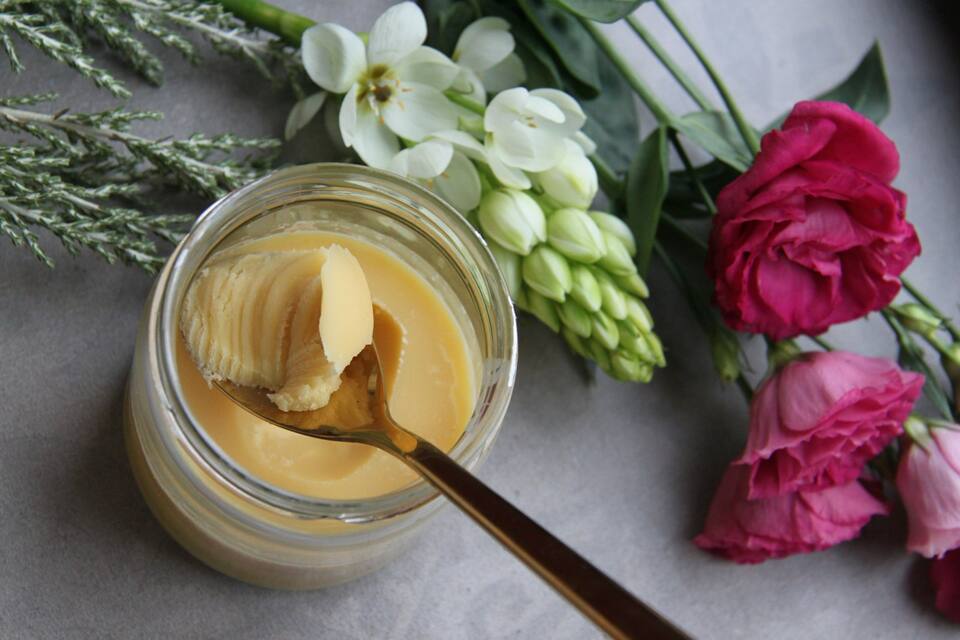
Ghee and butter start from the same place: cream from cow’s milk. What separates them is what happens next. Butter retains its water content (roughly 16–18%) and milk solids — the proteins and sugars that give butter its characteristic flavor and make it behave the way it does in baking. Ghee is butter with those components removed through a sustained heating process that evaporates the water and causes the milk solids to separate and be filtered away.
What you are left with when you make ghee is nearly pure butterfat — shelf-stable, golden, with a smoke point that makes it a genuinely different cooking tool. The comparison between ghee and butter is not really a question of which is better in some abstract sense. They are different fats suited to different cooking scenarios, and understanding where each excels changes how you approach a recipe.
This guide covers the practical differences: smoke point, flavor, nutritional profile, and the specific situations where each fat is the better choice.
Smoke Point: The Biggest Practical Difference
The most important practical distinction between ghee and butter for most cooks is smoke point — the temperature at which a fat begins to break down and smoke.
| Fat | Smoke Point |
|---|---|
| Butter (unsalted) | ~350°F (177°C) |
| Clarified butter | ~450°F (232°C) |
| Ghee (grass-fed) | ~485°F (252°C) |
| Refined coconut oil | ~450°F (232°C) |
| Extra virgin olive oil | ~375°F (190°C) |
Butter’s smoke point is constrained by its milk proteins and lactose. At around 300–350°F, these compounds begin to burn, producing a bitter taste and dark flecks. You have almost certainly experienced this: butter in a hot pan turns brown quickly, and if you push past that threshold, it tastes acrid rather than rich.
Ghee’s milk solids are gone. What remains is nearly pure fat, which can withstand high heat without burning. This is why ghee excels at applications that require sustained high heat: searing a steak, roasting vegetables at 425°F, deep-frying, or cooking a stir-fry where the pan temperature climbs quickly. The difference is not marginal — 135 degrees of additional heat tolerance fundamentally changes what the fat can do.
For reference, most home stovetop cooking (medium heat, 300–350°F) falls within butter’s working range. You can absolutely cook eggs or sauté onions in butter without burning it. The smoke point advantage for ghee becomes relevant at higher temperatures and longer cooking times.
Flavor: Similar Roots, Different Character
Both ghee and butter come from the same dairy fat, so there is obvious overlap in flavor profile. But the production process creates real differences.
Butter tastes rich and creamy with a milky sweetness. Its flavor is partly from the fat itself and partly from the milk solids — those proteins and sugars carry a lot of the characteristic dairy notes that make butter taste like butter. Fresh, high-quality butter from grass-fed cows has a complexity that is genuinely hard to replicate.
Ghee develops flavor differently. When butter is heated to clarify it, the milk solids undergo mild caramelization before they are filtered out. The Maillard reaction produces nutty, slightly toasted compounds that are absorbed into the fat. The result is a deeper, more savory flavor than butter — less milky, more complex, with a lingering richness. The exact flavor depends heavily on the production method: commercial ghee is often fairly neutral, while small-batch and Ayurvedic ghees (which use longer, slower simmering) develop more pronounced character.
For finishing dishes — drizzling over roasted vegetables, stirring into daal, or putting on toast — many people find ghee more satisfying than plain butter precisely because of this concentrated, caramelized quality. Others prefer butter’s familiar milky sweetness, particularly in Western cooking traditions where butter’s flavor is the expected one.
There is no wrong answer here. Cooking with both and comparing in context is the fastest way to develop your own preference.
Nutritional Profile
Ghee and butter are both predominantly saturated fat from animal dairy, and their macronutrient profiles per tablespoon are similar:
- Butter: approximately 11g total fat, 7g saturated fat, trace protein, trace carbs
- Ghee: approximately 13g total fat (slightly higher, because the water and milk solids removed from ghee concentrate the fat content), 8g saturated fat, 0g protein, 0g carbs
The meaningful nutritional distinction is in what ghee removes. Because the milk solids and water are filtered out:
- Lactose-free: Ghee contains essentially no lactose. Research suggests most lactose-intolerant individuals can tolerate ghee without symptoms, though this varies by individual sensitivity.
- Casein-free: Casein is the primary protein in dairy and the source of dairy allergies in many people. Ghee’s milk solids removal also removes casein, making it potentially tolerable for people with mild dairy sensitivity. (People with severe dairy allergy should verify with their healthcare provider.)
- Fat-soluble vitamins: Research suggests ghee from grass-fed cows contains meaningful amounts of fat-soluble vitamins A, D, E, and K2, as well as conjugated linoleic acid (CLA). Grass-fed butter also contains these compounds, and the relative amounts vary by production method and the specific dairy source.
The framing here matters. Neither ghee nor butter is a nutritional supplement, and neither should be treated as one. They are cooking fats. The question of which is “healthier” usually resolves to: if you have a lactose or casein sensitivity, ghee is the more tolerable option; otherwise, they are nutritionally comparable cooking fats where the quality of the dairy source matters more than the fat type.
When to Use Ghee vs Butter: Practical Guidance
Use ghee when
-
High-heat cooking
Searing proteins at 400°F+, deep-frying, roasting at high temperatures, and stir-frying in a wok are ghee's domain.
-
Dairy sensitivity is a concern
Ghee is the cleaner choice for lactose or casein sensitivity, though severe dairy allergy still requires medical guidance.
-
Long storage matters
Ghee is shelf-stable for months at room temperature and lasts significantly longer when refrigerated.
-
Indian and South Asian cooking
Daal tadka, biryani, roti, and similar dishes are calibrated around ghee's flavor and cooking behavior.
Use butter when
-
Baking needs structure
Butter's water creates steam and lift in croissants, puff pastry, cakes, cookies, and laminated dough.
-
A sauce needs emulsification
Beurre blanc, hollandaise, and similar sauces depend on butter's fat, water, and milk proteins.
-
The preparation is classically European
Sautéing in butter, finishing risotto, or making beurre noisette are built around butter's flavor and behavior.
-
You want familiar table flavor
On toast or bread, butter's creamy texture and milky flavor may be exactly the point.
Which Ghee Should You Buy?
If you are switching from butter to ghee for cooking or adding ghee alongside butter in your kitchen, here are the practical recommendations:
For everyday high-heat cooking: Fourth & Heart Original is the right starting point. USDA Organic, grass-fed, mid-range price, widely available. It has a clean, mildly nutty flavor that works across most cooking applications without competing with the ingredients.
For Ayurvedic cooking or maximum flavor depth: Ancient Organics produces ghee using traditional slow-simmering methods from biodynamic grass-fed milk. The flavor is more complex and pronounced than commodity ghee. Higher price, lower availability, but the choice for buyers who want the most authentic ghee experience.
If you want to try ghee without committing to a premium brand: Carrington Farms is USDA Organic and grass-fed at budget pricing. The flavor is milder than artisan brands, but it is a real, certified ghee and a reasonable way to test whether you want ghee in your regular kitchen rotation before investing in a more premium option.
Frequently Asked Questions
Can I substitute ghee for butter 1:1? ►
Yes — ghee substitutes for butter 1:1 in most cooking applications. In baking, ghee adds a slightly richer flavor and the absence of water can make some baked goods crisper.
Is ghee healthier than butter? ►
Ghee and butter have similar nutritional profiles. Ghee is lactose-free and casein-free because the milk solids are removed, which may make it more tolerable for people with mild dairy sensitivities. Research suggests ghee from grass-fed cows contains higher levels of conjugated linoleic acid (CLA) and fat-soluble vitamins compared to conventional butter.
Does ghee taste different from butter? ►
Yes — ghee has a richer, nuttier flavor because the milk solids caramelize during the clarification process. Many people find it more flavorful than butter for finishing dishes.
Why is ghee's smoke point so much higher than butter? ►
Butter's low smoke point (around 350°F) comes from the milk proteins and lactose it contains — these burn at relatively low temperatures. Ghee removes these milk solids, leaving nearly pure butterfat with a smoke point of approximately 485°F.
For a full comparison of the ghee brands we recommend, see our complete roundup of the best ghee brands or the interactive brand comparison table where you can filter by certifications, price tier, and dietary requirements.